Collections
An important selling point was the ability to break down content into collections. This provided an easier way of navigating, searching, and structuring, leading to a much better user experience for both staff and end users.
"We have a photograph collection of a little under 1000 images which covers a discrete period of Skidmore's history from 1925 to 1955. You could browse that, but it is not something that people want to do. So what I have done is that I have broken it down into categories. It was very easy to break it down in terms of things like images of faculties, classrooms, buildings, etc. This makes it easy for the end user to navigate by simply clicking the facet, like 1960, and then browsing through buildings from the 1960s."
Another very useful feature David highlights is the ability to browse collections. For example, you can browse the "1960s" collection and then use the search box to further search for whatever you are looking for (within the 1960s). So, instead of using a complicated search query, you can jump straight to that point and start searching from there.
The Workflow
David's current project, digitizing the college’s alumni publication Skidmore Scope, will be about a year-long project. The magazine is still in print but will now be available in digital format. Here is David's description of the project workflow:
- Step 1 is to ascertain the collection involved in terms of volume. He creates a detailed list of the actual volumes and gathers the various simple metadata like size, title, editor, etc.
- Step 2 is the digitization process which, in this case, involves using a flatbed scanner. He digitizes in bulk, meaning he does all the digitizing work simultaneously. For this project, he did about 6500 pages in 6-7 weeks.
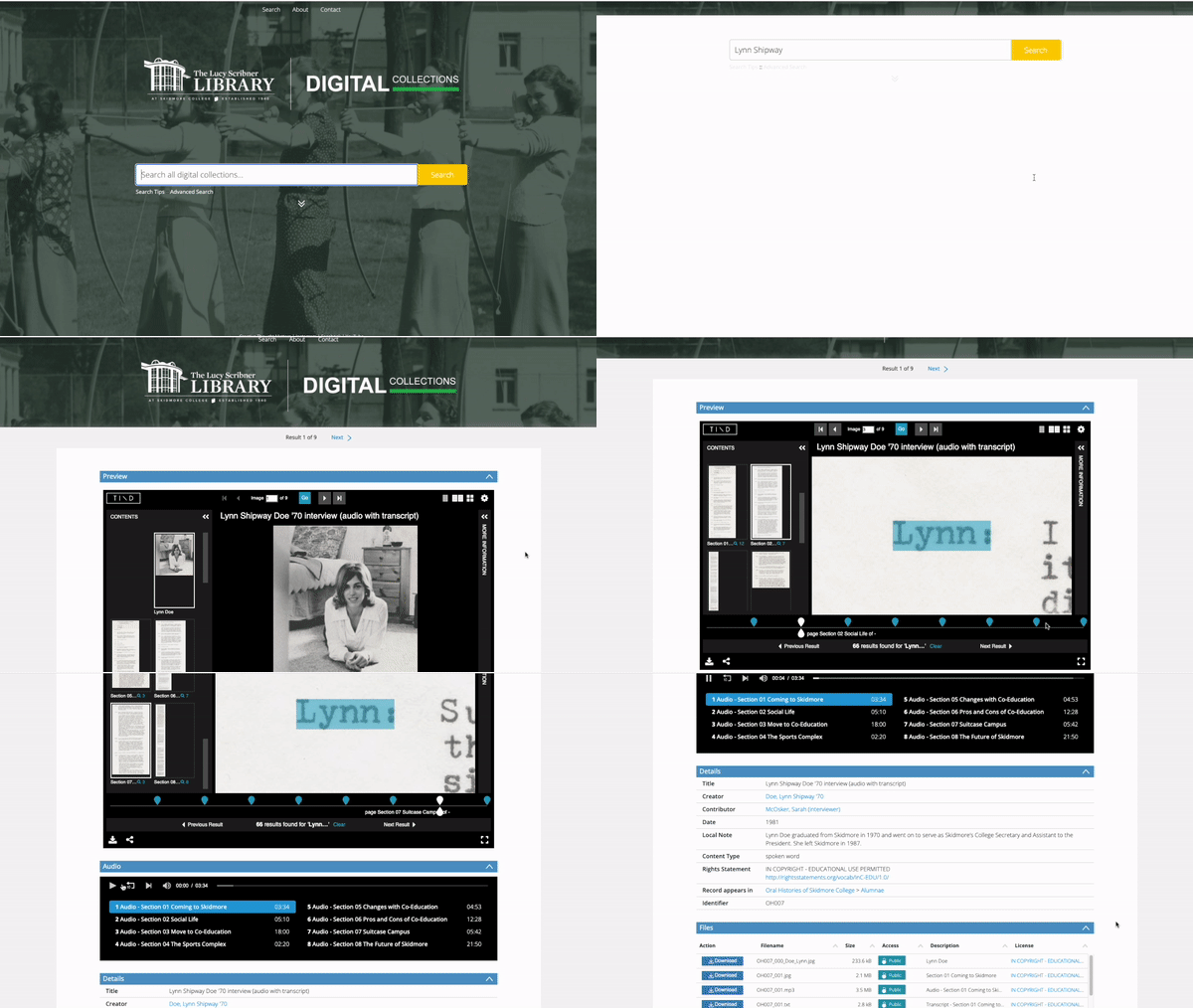
- To ensure that all the material is full-text searchable, all the files are OCR`d. For each JPEG, he also creates text files that are included in the viewer. That way, it's possible to see the transcript alongside the image. HOCR for the JPEGs is done by using Tesseract.
- While waiting for the pages to be HOCR`d, he simultaneously creates the spreadsheets for metadata. The spreadsheet is converted to XML during the batch upload process. Each spreadsheet is built on the previous one.
- For uploading, David is using TIND's FTP server. He uploaded all of the files and metadata in bulk with the batch uploader.
Customer Care
David also highlights great customer care as one of the most important selling points in terms of dealing with TIND. To him, it was important to have a personal connection with someone who knew him. And even though TIND has grown in terms of staff and customers, he feels there is still a nimbleness and a desire to respond to customers in the same way.
"A big selling point in terms of dealing with TIND was that they were like “yeah, I think we can work that out. We came up with solutions together for different things that were important for us, and TIND created those capabilities for us.”
The migration
The project involved migrating 122,500 files spread over 3582 records in 17 collections from CONTENTdm - including OCR`d transcripts, audio recordings, PDFs, JPEGs, and text files.
"The process was painstaking given the amount of material involved and the special demands we had with respect to the inclusion of text file transcripts for most records as well as audio files for an oral history collection. And, at the time of our initial decision to purchase TIND DA, the product did not yet have the capability to accommodate either. During the migration process, TIND made changes to the image viewer to allow for the inclusion of text file transcripts. They came up with a solution for displaying and playing audio files, both of which were rolled out to the wider community after our migration."
“It's been a pretty smooth operation.” - David Seiler